Pages

Showing posts with label Indo-pak wars. Show all posts

Saturday, November 09, 2013

1965 War (2nd Kashmir War); 1999 Kargil War; 2002 Military Standoff

India and Pakistan had fought in 1965 and 1999 skirmishes for gaining control on Land of Kashmir, but both of them could not  decide Fate of Kashmir and dispute remained unsolved; during Musharraf-Vajpayee rein in 2001-2002(Operation Parakram) a great military standoff was seen and both countries mobilized massive military forces in Kashmir region, and a threat of nuclear war was widespread out. But the standoff resulted in negotiations and removal of forces from Jammu & Kashmir "LoC".

Indo-Pakistan War 1965

Also known as 2nd kashmir war ; The 1965 war was the biggest tank war after 2nd world war  the war was fought by the countries' land forces in Kashmir and along the International Border between India and Pakistan. This war saw the largest amassing of troops in Kashmir since the Partition of British India in 1947, a number that was overshadowed only during the 2001–2002 military standoff between India and Pakistan. Most of the battles were fought by opposing infantry and armoured units, with substantial backing from air forces, and naval operations.
The war ended in Victory of Pakistan but left heavy casualties and loses on both sides.

1999 Kargil Conflict

The Kargil War also known as the Kargil conflict, was an armed conflict between India and Pakistan that took place between May and July 1999 in the Kargil district of Kashmir and elsewhere along theLine of Control (LOC). The conflict is also referred to as Operation Vijay which was the name of the Indian operation to clear the Kargil sector.
The cause of the war was the infiltration of Pakistani soldiers and Kashmiri militants into positions on the Indian side of the LOC,which serves as the de facto border between the two states. During the initial stages of the war, Pakistan blamed the fighting entirely on independent Kashmiri insurgents, but documents left behind by casualties and later statements by Pakistan's Prime Minister and Chief of Army Staff showed involvement of Pakistani paramilitary forces, led by General Ashraf Rashid. The Indian Army, later on supported by the Indian Air Force, recaptured a majority of the positions on the Indian side of the LOC infiltrated by the Pakistani troops and militants. With international diplomatic opposition, the Pakistani forces withdrew from the remaining Indian positions along the LOC.
The war is one of the most recent examples of high altitude warfare in mountainous terrain, which posed significant logistical problems for the combating sides. To date, it is also the only instance of direct, conventional warfare between nuclear states.
Kargil Sector And Positions of Mujahideen


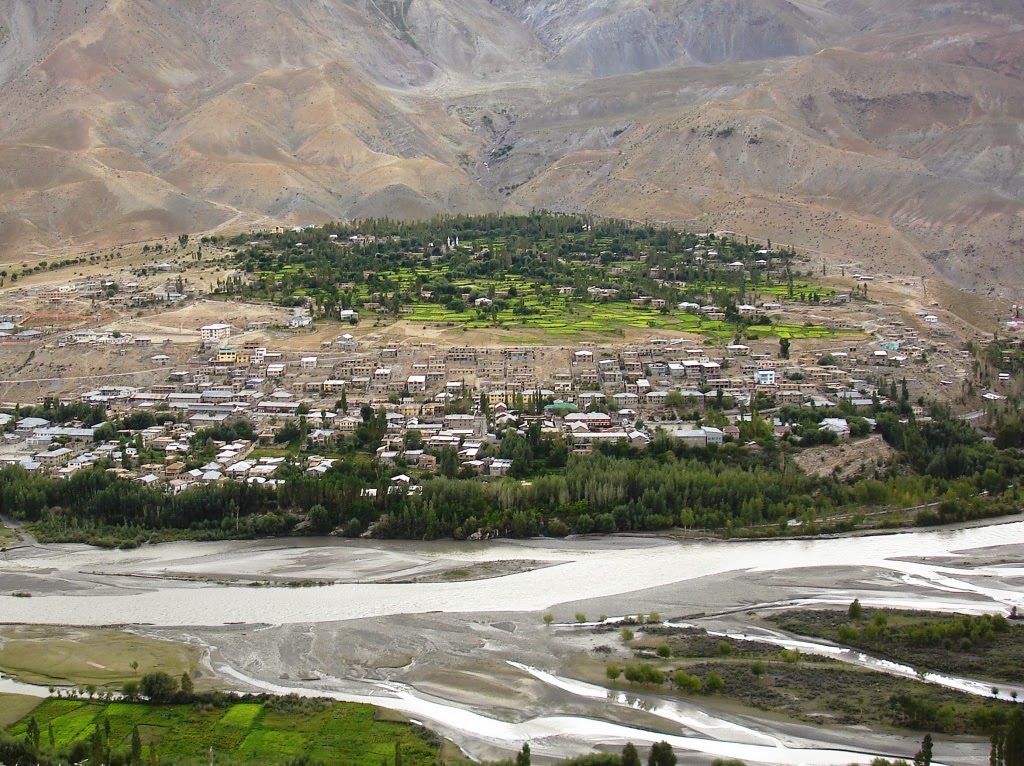
Bueatiful Landescape of strategically important Kargil Town 


2001-2002 Military Standoff

The 2001–2002 India–Pakistan standoff was a military standoff between India and Pakistan that resulted in the massing of troops on  either side of the International Border (IB) and along the Line of Control (LoC) in the region of Kashmir. This was the second major military standoff between India and Pakistan following the successful detonation of nuclear devices by both countries in 1998 and the most recent standoff between the nuclear rivals. The other had been the Kargil War in 1999.
The military build up was initiated by India responding to a terrorist attack on the Indian Parliament on 13 December 2001 (during which twelve people, including the five men who attacked the building, were killed) and Jammu and Kashmir Legislative Assembly on 1 October 2001.  India claimed that the attacks were carried out by two Pakistan based Terrorist groups fighting Indian rule in Kashmir, Lashkar-e-Taiba and Jaish-e-Mohammad, both of whom India has said are backed by Pakistan's intelligence ISI  a charge that Pakistan denied. In the Western media, coverage of the standoff focused on the possibility of a nuclear war between the two countries and the implications of the potential conflict on the United States-led War on Terrorism in Afghanistan. Tensions de-escalated following international diplomatic mediation which resulted in the October 2002 withdrawal of Indian and Pakistani troops  from the international border. But still India suffered 1,874 casualties without fighting a war. The number of Army personnel killed or wounded in Jammu and Kashmir and the western sector during the mobilisation, Operation Parakram, from December 19, 2001 to October 16, 2002, was 1,874. Both countries also saw heavy financial loses, The Indian cost for the buildup was INR216 billion (US$3.3 billion) and that of Pakistan was $1.4 billion. 

Wednesday, November 06, 2013

Kashmir War of Independence (Indo-Pakistani War of 1947)

                     The Indo-Pakistani War of 1947–1948, sometimes known as the First  Kashmir War, was fought between India and Pakistan over  the princely state of Kashmir and Jammu from 1947 to 1948. It was the first of four wars fought between the two newly independent nations. Pakistan precipitated the War a few weeks after independence by launching tribal lashkar (militia) from Waziristan in an effort to wrest Kashmir from India. The result of the war still affects the geopolitics of both countries.After rumours that the Maharaja supported the annexation of Kashmir by India, militant Muslim revolutionaries from Poonch district and particularly from Sudhanuti Subdivision of western Kashmir and Pakistani tribesmen made rapid advances into the Baramulla sector with the Sudhan armies of Sardar Ibrahim Khan And Caption Hussain Khan. Maharaja Hari Singh of Kashmir asked the government of India to intervene. However, India and Pakistan had signed an agreement of non-intervention. Although tribal fighters from Pakistan had entered Jammu and Kashmir, there was no iron-clad legal evidence to unequivocally prove that Pakistan was officially involved. It would have been illegal for India to unilaterally intervene in an open, official capacity unless Jammu and Kashmir officially joined the Union of India, at which point it would be possible to send in its forces and occupy the remaining parts.
Ghazi-i-Millat Sardar Muhammad Ibrahim Khan as the, 32 years old, first President of Azad Kashmir.
                     The Maharaja desperately needed military assistance when the Pakistani tribals reached the outskirts of Srinagar. Before their arrival into Srinagar, India argued that the Maharaja must complete negotiations for ceding Jammu and Kashmir to India in exchange for receiving military aid. The agreement which ceded Jammu and Kashmir to India was signed by the Maharaja and Lord Mountbatten of Burma. In Jammu and Kashmir, National Conference volunteers worked with the Indian Army to drive out the Pakistanis.
Col. Khan Muhammad Khan The Father of Poonch  , Leader and  Commander Of Kashmiri Militias
                 In November 1948, The Indian and Pakistani governments agreed to hold the plebiscite, but Pakistan did not withdraw its troops from Kashmir, thus violating the conditions for holding the plebiscite. In addition, the Indian Government distanced itself from its commitment to hold a plebiscite.India proposed that Pakistan withdraw all its troops first, calling it a precondition for a plebiscite. Pakistan rejected on the grounds that the Kashmiris may not vote freely given the presence of Indian army and Sheikh Abdullah's friendship with the Indian Prime Minister, Jawaharlal Nehru. However, Pakistan proposed simultaneous withdrawal of all troops followed by a plebiscite under international auspices, which India rejected. Hence Pakistan didn't withdraw its forces unilaterally In addition, the Indian Government distanced itself from its commitment to hold a plebiscite. Over the next several years, the UN Security Council passed four new resolutions, revising the terms of Resolution 47 to include a synchronous withdrawal of both Indian and Pakistani troops from the region, per the recommendations of General Andrew McNaughton. To this end, UN arbitrators put forward 11 different proposals for the demilitarisation of the region. All of these were accepted by Pakistan, but rejected by the Indian government. The resolutions were passed by United Nations Security Council under Chapter VI of the United Nations Charter. Resolutions passed under Chapter VI of the UN charter are considered non-binding and have no mandatory enforceability, as opposed to the resolutions passed under Chapter VII.The resulting war over Kashmir, the First Kashmir War, lasted until 1948, when India moved the issue to the UN Security Council. Sheikh Abdullah was not in favour of India seeking UN intervention because he was sure the Indian Army could free the entire State of invaders. The UN had previously passed resolutions for setting up monitoring of the conflict in Kashmir. Following the set-up of the United Nations Military Observer Group in India and Pakistan (UNCIP), the UN Security Council passed Resolution 47 on 21 April 1948. The resolution imposed an immediate cease-fire and called on the Government of Pakistan 'to secure the withdrawal from the state of Jammu and Kashmir of tribesmen and Pakistani nationals not normally resident therein who have entered the state for the purpose of fighting.' It also asked Government of India to reduce its forces to the minimum strength, after which the circumstances for holding a plebiscite should be put into effect 'on the question of Accession of the state to India or Pakistan. However, both India and Pakistan failed to arrive at a Truce agreement due to differences in interpretation of the procedure for and extent of demilitarisation one of them being whether the Azad Kashmiri army is to be disbanded during the truce stage or the Plebiscite stage.
The tribal men were accused to be involved in unrest caused in Kashmir
The Instrument of Accession of Kashmir to India was accepted by Viceroy Louis Mountbatten, 1st Earl Mountbatten of Burma.